


- Início
- Log TV
- Agenda
- Artigos
- Notícias
- Entrevistas
- Log Content
- Especiais
- Revistas
- Supply Chain Insights
- América Latina


Corredor verde Pecém-Rotterdam-Duisburg e seus 3 Mosqueteiros: uma parceria que pode mudar o papel dos portos na transição energética


* Texto disponível em inglês ao final / Original english article available below
O corredor de energia verde entre os portos de Pecém, Roterdã e Duisburgo é promissor por vários motivos: a rota de curta distância que conecta a produção brasileira à demanda europeia está sendo construída sobre bases sólidas e sobre infraestrutura de alto nível já existente. A cooperação que torna isso possível é conduzida por importantes líderes que gostamos de chamar de os Três Mosqueteiros do Hidrogênio Verde , e são eles Johannes Eng (que você já conhece de uma coluna anterior), Wouter Demenint, do Porto de Roterdã, e o orgulho nacional brasileiro Fabio Grandchamp, do Complexo do Pecém.
A Tecnologística reuniu esses Três Mosqueteiros para uma entrevista emocionante, feita durante a Messe de Hannover. Aproveite!
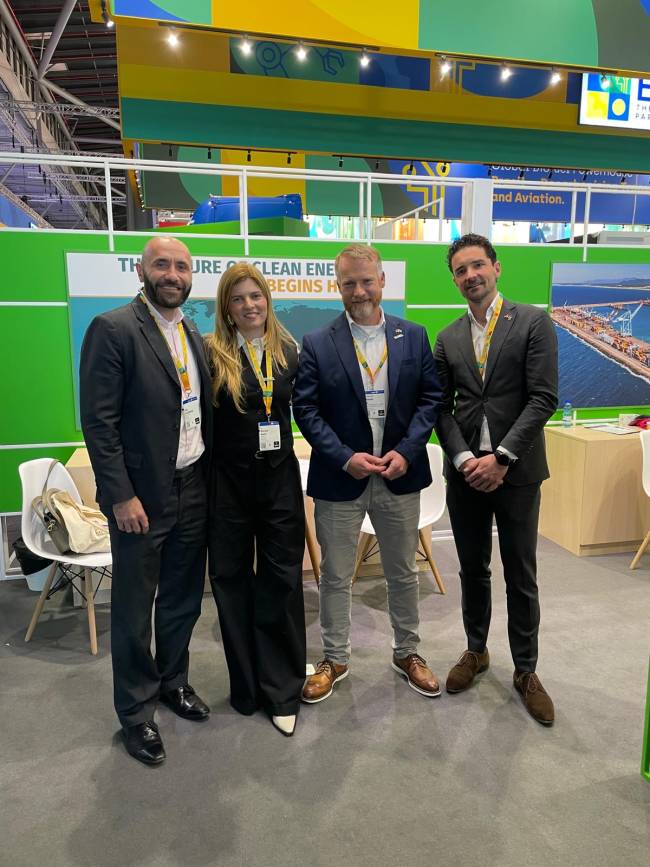
Mariana Avelar – Tecnologística: O cenário energético global está mudando rapidamente em meio às tensões geopolíticas (que aumentam desde a guerra no Irã) e às exigências climáticas. Como o hidrogênio se encaixa nessa equação complexa e qual papel a parceria Pecém-Roterdã-Duisburg desempenha na resolução desses desafios?
Wouter Demenint (Porto de Rotterdam): A cadeia de suprimentos de hidrogênio surge na confluência de vários elementos críticos... a incerteza geopolítica é um ponto crucial, mas também o imperativo mais amplo da transição energética.
Para elaborar sobre a dimensão geopolítica e o que alguns percebem como um 'retorno ao combustível fóssil': precisamos comunicar de forma muito mais eficaz que o hidrogênio não é o oposto da segurança energética.
Muito pelo contrário: faz parte da solução para o próprio problema da incerteza geopolítica e uma alternativa genuína aos combustíveis fósseis.
Isso forma o pano de fundo para nossa parceria de três portos: buscamos escolher os aliados certos no cenário mundial. Estamos incorporando uma amizade entre nações que compartilham valores comuns.
Parcerias como o corredor de hidrogênio verde Pecém-Rotterdam-Duisburg oferecem uma solução concreta para a incerteza que enfrentamos hoje.
O Porto de Roterdã tornou-se acionista do Porto de Pecém em 2018. Na época, ainda não compreendíamos plenamente seu potencial para produção de hidrogênio em Pecém, embora certamente reconhecêssemos a força das fontes de energia renovável do Brasil: a vasta matriz de energia renovável do Brasil sempre fez parte dessa visão. Posteriormente, em 2019, desenvolvemos nossa estratégia de hidrogênio no Porto de Roterdã e identificamos imediatamente o potencial da Pecém como fornecedor. A partir desse momento, começamos a colaborar com a Pecém para ajudar a desenvolver e moldar a visão do hidrogênio deles. Ser acionista tornou consideravelmente mais fácil construir as bases para essa parceria com o hidrogênio.
Em meio aos inúmeros projetos que surgiram e fracassaram durante o 'hype do hidrogênio', temos defendido consistentemente o potencial do projeto Pecém.
Com Duisburg, nosso relacionamento se estende por muitas décadas, ou melhor dizendo, séculos. É a conexão interior mais significativa que temos no Porto de Rotterdam, com uma troca anual de aproximadamente 100 milhões de toneladas de carga.
Mariana Avelar - Tecnologística: o maior porto marítimo da Europa (Rotterdam) e o maior porto interior do mundo (duisport): parceiros naturais, de fato. Como essa parceria triádica foi formalizada?
Wouter Demenint (Porto de Rotterdam): No lado europeu: faz sentido estender as conexões de hidrogênio planejadas por Roterdã mais para dentro da Alemanha, especialmente para a Renânia do Norte-Vestfália—frequentemente chamada de batida do coração da Europa.
O slogan é mais do que merecido: é uma região industrial vibrante com necessidades substanciais de importação de energia. O hidrogênio, portanto, faz todo sentido como parte dessa matriz energética.
Temos trabalhado juntos para alinhar essa cadeia de suprimentos com as atividades produtivas em Pecém, onde vários projetos estão em andamento. Em Roterdã, estamos desenvolvendo a infraestrutura de importação para receber o produto e criar uma conexão com Duisport, onde estão localizados os principais compradores industriais.
Construir um corredor de hidrogênio bem-sucedido exige alinhamento por toda a cadeia de valor — não apenas no nível comercial, mas também nos níveis institucionais e governamentais. Nossa ambição é demonstrar ao mundo que essa oportunidade na cadeia de suprimentos é real e que devemos capitalizá-la.
Mariana Avelar – Tecnologística: Já que chegamos à questão da governança e coordenação, gostaria de levantar uma pergunta que surge com frequência: como funciona a parceria? Como as prioridades são determinadas?
Johannes Eng (duisport): Cada porto e sua respectiva equipe cumprem funções específicas que refletem a própria cadeia de suprimentos de hidrogênio. Pecém serve como porto exportador, beneficiando-se de condições favoráveis para a produção devido à abundante disponibilidade de fontes de energia renovável. O Porto de Roterdã é o porto importador, e Duisport é o porto receptor, conectando o produto à demanda. Juntos, os três portos constroem pontes, enfrentando coletivamente os desafios que surgem de nossas posições individuais dentro da cadeia de suprimentos. Avaliamos diferentes opções juntos e montamos as peças do quebra-cabeça em um quadro coeso: a Pecém atua com a produção, a Rotterdam com o envio e manuseio, e na Duisport, nos comunicamos com a parte de compra e distribuição.
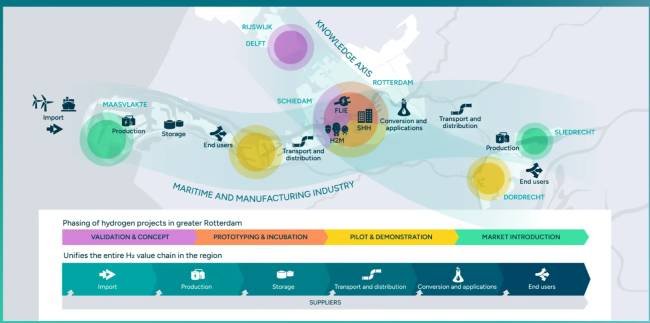
(Fonte: LAUNCH₂)
Mantemos uma relação próxima, e se surgir uma dúvida sobre as especificidades de uma das portas, está apenas a uma ligação telefônica de ser resolvida. Não há uma estrutura rígida, mas estamos bem coordenados nos pontos essenciais para que o corredor verde prospere, e avançamos com a cooperação ao longo do caminho.
Nossas diferentes áreas de expertise e perspectivas nos permitem estruturar a parceria com uma perspectiva completa de ponta a ponta, com uma visão de helicóptero, por assim dizer.
Wouter Demenint (Porto de Roterdã): Para acrescentar a isso: nossa coordenação também vem dessa 'visão de helicóptero' que temos sobre toda a cadeia de suprimentos.
As empresas individualmente consideradas tendem a focar em seu segmento específico da cadeia de suprimentos, tanto em termos de interesses quanto de visão.
Em contraste, podemos adotar uma visão mais ampla, abrangendo todas as empresas que atuam na cadeia de suprimentos, bem como os governos. Fazemos conexões e ajudamos a coordenar todas essas partes como uma entidade neutra: embora não sejamos os tomadores de decisão, podemos ajudar a direcionar todos na mesma direção.
Mariana Avelar – Tecnologística: Isso toca em uma lição que aprendi anteriormente com Johannes: os portos desempenham um papel crucial no desenvolvimento dos diversos elos da cadeia de suprimentos de hidrogênio em direção ao interesse público, justamente por causa dessa neutralidade.
Johannes Eng (duisport): Podemos conduzir as discussões na direção certa, ajudando as partes a se alinharem. Somos neutros, já que não tomamos parte do comércio real.
Em vez de focar apenas em estratégias comerciais individuais, ajudamos a desenvolver novas soluções livres de viés.
Permita-me ilustrar com um exemplo: do ponto de vista final da cadeia de suprimentos, há três perguntas fundamentais sendo feitas:
- De onde o produto vai vir?
- Como funciona?
- E quanto isso vai custar?
Devido ao nosso posicionamento único, podemos fornecer respostas para todas as três perguntas. E essa é, provavelmente, a mensagem mais poderosa que podemos transmitir. Reunimos líderes de mercado e facilitamos negócios genuínos; com isso quero dizer que facilitamos o trabalho real e não apenas construção de apresentações em PowerPoint. A credibilidade que as autoridades portuárias trazem é um ativo que muda o jogo.
Mariana Avelar – Tecnologística: Fábio, além da credibilidade dos stakeholders, construir um novo mercado invariavelmente envolve navegar por estruturas regulatórias complexas. Quais são os principais desafios que você encontra na construção dessa economia nascente do hidrogênio?
Fabio Grandchamp (Complexo do Pecém): Construir um novo mercado abrange múltiplas dimensões: desde o movimento físico dos produtos e a estruturação de sua cadeia de suprimentos, até a regulamentação que inevitavelmente é necessária.
No porto, podemos unir empresas e governo para alcançar o desenvolvimento econômico e social esperado.
O corredor verde facilita um melhor alinhamento logístico entre Europa e Brasil, não apenas entre empresas privadas, mas também entre autoridades públicas que regulam os mercados de hidrogênio de baixo carbono. Temos, por exemplo, uma questão urgente diante de nós sobre a certificação de hidrogênio. A coordenação desses processos é fundamental, já que estamos discutindo produtos que cruzarão fronteiras.
Mariana Avelar – Tecnologística: Este tema está entre minhas principais preocupações com o hidrogênio: o hidrogênio de baixo carbono produzido no Brasil será reconhecido como hidrogênio verde em solo europeu?
Fabio Grandchamp (Complexo do Pecém): É uma preocupação legítima. No lado da cadeia de suprimentos, estamos avançando consideravelmente. No entanto, se não tivermos essas outras peças no lugar (incluindo clareza sobre esquemas de certificação), o produto não poderá ser movido. É por isso que trabalhar na prontidão do lado governamental é tão importante.
Fizemos progressos no Brasil, mas não a ponto de conseguirmos resolver todas as questões. Nosso arcabouço legal ainda não está totalmente implementado. O próximo passo crítico é a implementação dos detalhes regulatórios que sustentam a legislação já aprovada. Esse regulamento detalha como os projetos poderiam ter acesso aos subsídios.
No lado europeu, também há inúmeras definições ainda a serem finalizadas, especialmente em relação a produtos importados.
Mariana Avelar – Tecnologística: O Complexo Pecém ocupa uma posição extraordinária dentro desses novos marcos comerciais. O que torna Pecém tão distinto, Fábio?
Fábio Grandchamp (Complexo do Pecém): Acredito que há vários elementos que nos colocam em uma posição altamente favorável nessa agenda. Como você mencionou, a acessibilidade e a abundância de energia renovável em nosso complexo são realmente excepcionais.
E, claro, nossa zona de livre comércio (ZPE) torna o complexo excepcionalmente competitivo para a exportação de hidrogênio verde.
De qualquer forma, é importante enfatizar que também estamos partindo de uma plataforma já existente: há uma área industrial produtiva junto com um porto que estão em operação há mais de vinte anos. Isso elimina uma parte substancial dos riscos de viabilidade que frequentemente causam o fracasso de projetos de hidrogênio.
Considerando que temos dois acionistas distintos (o Estado do Ceará e o Porto de Roterdã), já temos, por consequência, uma infraestrutura de governança avançada e que está alinhada com os objetivos do corredor verde.
De um lado, o Porto de Roterdã traz oportunidades notáveis, juntamente com sua expertise nos mercados europeus. Por outro lado, o governo local brasileiro mantém um diálogo qualificado com o governo federal e com a comunidade local. Essa é mais uma peça do quebra-cabeça que torna nossa proposta de valor bastante única.
E acredito que também devemos considerar a perspectiva geopolítica que coloca o Brasil em uma posição distinta, posição esta que a Europa deveria examinar com mais atenção.
Não estamos falando apenas de um curto tempo de navegação entre Pecém e a Europa, mas de outras vantagens do corredor: não há ponto de estrangulamento nem zonas vermelhas ao longo da rota. Em um momento em que a Europa busca diversificar seu fornecimento de energia, o Brasil se torna um parceiro altamente relevante nesse sentido.
Pecém pode entregar moléculas verdes para a Europa em grande escala a longo prazo e pode fazê-lo de maneira competitiva e confiável.
Mariana Avelar – Tecnologística: Wouter, tenho particular interesse na consulta de mercado realizada pelo Porto de Rotterdam sobre o desenvolvimento de terminais de importação para hidrogênio e seus transportadores. Quais insights surgiram desse processo e quais desafios regulatórios ainda permanecem?
Wouter Demenint (Port of Rotterdam): Uma parte considerável dos pontos que você mencionou está relacionada a questões específicas holandesas que enfrentamos.
A consulta de mercado para terminais a que você se referiu ainda está em andamento. Embora já estejamos vendo alguns resultados preliminares, muitos dos principais obstáculos identificados não são de natureza financeira. Um dos desafios mais significativos é o congestionamento da rede. Esse problema está sendo resolvido por meio da expansão da rede para acompanhar a eletrificação e avaliando o espaço de manobra entre as empresas, ou seja, avaliando a possível lacuna entre a capacidade de conexão à rede que solicitaram e o que realmente precisam.
Estávamos realmente explorando o que os terminais exigem para tomar decisões finais de investimento e, ainda assim, as chances são de que nem todos atinjam tal decisão final. A desaceleração do mercado de hidrogênio é, por um lado, problemática para garantir a demanda. Por outro, ajuda a resolver parte das limitações da infraestrutura, como os gargalos da rede elétrica. Funciona, em última análise, como um processo de seleção natural para os projetos: nem todos os projetos em terminais serão viáveis no curto prazo, mas isso também permite tempo para resolver os gargalos atuais, garantindo que tenhamos capacidade suficiente no futuro.
Outro fator crítico é a conectividade com a rede de dutos de hidrogênio, que é determinante para definir o cronograma. Apesar dos atrasos anunciados, o governo holandês forneceu uma garantia para que a Hynetwork/Gasunie inicie o desenvolvimento do gasoduto de hidrogênio mesmo sem demanda. Em outras palavras, a infraestrutura está sendo construída antecipando o mercado, em vez de esperar que a demanda se materialize primeiro.
Estamos confiantes de que a conexão com a Alemanha estará disponível até 2032 por meio de um gasoduto para transporte de hidrogênio. Enquanto isso não ocorre, já existem outras modalidades logísticas em vigor, como barcaças de navegação interior e conexões ferroviárias que podem transportar amônia e metanol.
Muita discussão tende a focar no gasoduto, mas outras alternativas logísticas também estão já disponíveis. Os projetos normalmente começam em menor escala, para os quais modos alternativos de transporte podem ser tanto práticos quanto econômicos. Portanto, discussões sobre investimentos em gasodutos devem sempre considerar a escala e como acelerar esse desenvolvimento.
É perfeitamente aceitável começar com barcaças interiores e transporte ferroviário para trazer os primeiros volumes para a Europa, e depois escalar gradualmente quando o gasoduto estiver operacional para transportar volumes maiores.
O desenvolvimento de infraestrutura e a maturidade do mercado levam tempo. Olhando para trás, o desenvolvimento da indústria de petróleo e gás demandou cento e cinquenta anos para chegar onde estão hoje. Para energia solar e eólica, levou pelo menos vinte e cinco anos para se atingir os níveis atuais de desenvolvimento. O desenvolvimento atual do hidrogênio começou há aproximadamente cinco anos. Não é realista esperar que tudo já esteja no lugar nesse momento.
Agora estamos em uma trajetória mais realista, aumentando gradualmente, e estou confiante de que faremos isso acontecer. E acredito que essa abordagem é benéfica para a credibilidade.
Mariana Avelar – Tecnologística: Diante desta discussão sobre infraestrutura de gasodutos, como as modalidades logísticas existentes (como petroleiros interiores e ferrovias) complementam a futura rede de gasodutos?
Johannes Eng (duisport): Como estamos discutindo conexões por gasodutos, é importante lembrar que essa infraestrutura coexistirá com as operações atuais de petroleiros interiores navegando entre os portos, como já é prática comum hoje em dia.
Para colocar isso em perspectiva: a TanQuid (atualmente em fase de rebranding, após aquisição pela Sunoco) opera um dos maiores terminais de tanques interiores da Europa, no porto de Duisburg, com capacidade de 250.000 metros cúbicos. É enorme e demonstra que não precisamos esperar os pipelines começarem a crescer. É inegável que os gasodutos são um excelente meio para transporte de massa, mas exigem uma escala que muitas vezes não é viável para novos mercados, como o hidrogênio verde.
Para ter uma impressão direta de quão capaz e movimentado é o Rio Reno e o Porto de Duisburg, você pode conferir os sinais do transponder AIS online. Colocando isso em perspectiva, as embarcações para produtos líquidos a granel já representam cerca de 1/3 da frota total de navegação interior atualmente.
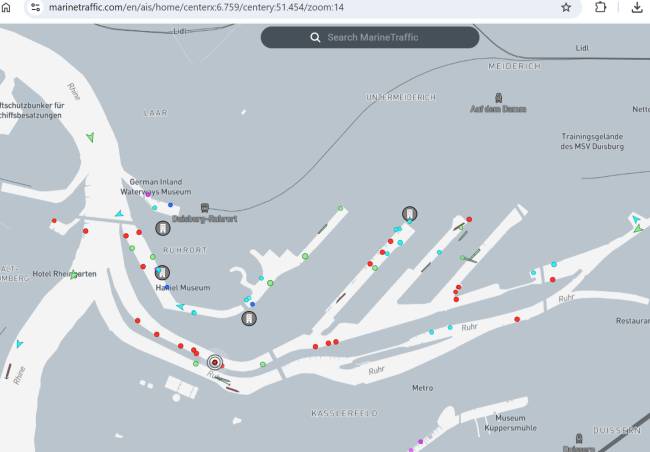
(Fonte: Tráfego Marítimo – 06/11/2026, 23:00)
Meu ponto é este: grande parte do que é necessário para viabilizar a cadeia do hidrogênio já está disponível hoje. Podemos expandir com soluções já existentes, como barcaças, tankers/embarcações de granel líquido e ferrovias, enquanto simultaneamente planejamos e construímos o gasoduto para consumidores em grande escala. Tudo converge porque, quando os volumes já foram aumentados, você tem o gasoduto pronto, junto com barcaças e produtos de transporte ferroviário também.
O que as empresas querem e precisam na Europa, especialmente em meio à atual incerteza geopolítica, é opcionalidade, contingência e redundância no sistema. Não podemos depender apenas do gasoduto. Se algo der errado com eles, ainda temos barcaças e produtos de transporte ferroviário.
Mariana Avelar – Tecnologística: Johannes, gostaria de ouvir sua perspectiva sobre como o porto está evoluindo para encarar o futuro, ou melhor, para ser 'preparado para o futuro'.
Johannes Eng (duisport): Isso nos leva de volta ao que já discutíamos.
Em algum momento, talvez há dez anos, quando as preocupações com a transição energética ainda surgiam, entendemos que algo significativo estava por vir e que precisaríamos enfrentá-lo indo além do tradicional negócio portuário.
Isso nos levou a três perguntas fundamentais:
- Que tipo de infraestrutura precisamos?
- Estávamos discutindo terminais para novos produtos que poderim surgir.
- Quem estará envolvido?
Percebemos que a evolução do porto envolve o engajamento com novos parceiros, regiões e fontes de fluxo de carga.
Como podemos, a partir da posição de uma autoridade portuária, ajudar a construir o ecossistema e o modelo de distribuição para aproximar os consumidores?
Responder a essas perguntas nos deu tarefas muito práticas para enfrentar e um cronograma exigente atrelado a tais tarefas: tudo o que fazemos hoje tem um atraso de pelo menos cinco anos para se tornar realidade.
Assim, se quisermos encontrar uma solução para hoje, deveríamos ter começado a contemplá-la há cinco anos. É isso que fazemos para tornar o porto à prova de futuro.
As parcerias consolidadas agora são possíveis graças a esse esforço. Hoje, estamos discutindo as questões que a indústria provavelmente enfrentará daqui a cinco anos.
E, para enxergar de forma mais positiva, é isso que a logística faz, de qualquer forma. Estamos encontrando soluções e construindo modelos operacionais que podem preencher as lacunas que já identificamos.
E como isso leva tempo e tem uma aspiração de longo prazo, as autoridades portuárias são particularmente valiosas. Eles podem começar cedo o suficiente, sem viés de curto prazo e considerando a lógica integral da cadeia de suprimentos e construindo soluções eficazes em tempo hábil. Agimos antes que a pressão por mudanças se torne intensa demais, ou pior, antes que seja tarde demais.
Wouter (Porto de Roterdã): Desenvolvemos cenários no Porto de Roterdã, considerando como acreditamos que o futuro se desenrolará.
Temos quatro cenários e, essencialmente, estamos tentando acomodar eles construindo a base para a infraestrutura que precisaremos. Fazendo isso, conseguimos escalar rapidamente para o cenário mais otimista ou, no mínimo, estar preparados com o que é necessário para o cenário mais pessimista. Não podemos fazer previsões precisas, mas nossa visão para 2050 nos ajuda a estar preparados para o que acontecer, com flexibilidade para nos adaptarmos rapidamente.
Mariana Avelar – Tecnologística: No Brasil, diríamos que esse é o desafio de trocar os pneus de um carro em movimento. Como a visão de futuro de Pecém está tomando forma, considerando essa dinâmica?
Fábio Grandchamp (Complexo do Pecém): Como estamos discutindo esse novo mercado, já estabelecemos as condições para a produção de hidrogênio verde e sua conversão em amônia para entrega ao mercado europeu. Mas também estamos nos preparando para possíveis mudanças na demanda: é possível que, no futuro, a prioridade seja exportar metanol ou aço verde.
É importante não se envolver com discursos exclusivistas: não é hidrogênio verde contra aço verde ou indústria local. É hidrogênio e aço, não 'ou'.
Acredito que é importante que comecemos essa agenda de exportação para alcançar escala, reduzir custos e nos tornar mais competitivos. Isso vai incentivar a indústria local a se interessar por essas moléculas verdes. Ao fazer isso, criamos a base para a demanda local por hidrogênio verde no futuro, e prevemos que soluções multimodais virão a seguir.
Por enquanto, a prioridade é que o porto esteja pronto para o manuseio da amônia, porque é para lá que os projetos atuais estão indo. Mas no futuro, estou confiante de que outras moléculas como o metanol estarão na agenda, então o porto também está sendo preparado para lidar com metanol, considerando que provavelmente servirá como combustível de abastecimento para navios. Várias empresas e companhias de navegação já possuem motores híbridos. Estamos caminhando para um futuro multicombustível, e os portos também estão caminhando nessa direção.
Johannes Eng (duisport): Talvez você possa acrescentar uma última observação sobre isso também. Como somos autoridades portuárias, somos totalmente agnósticos.
Estamos abertos a tudo o que o mercado exigir. Mas o ponto é que estamos construindo projetos que vão evoluir para soluções futuras. Estamos discutindo amônia no momento, e a solução por trás disso é a mesma que se estivéssemos discutindo metanol.
Apesar de ser um produto diferente, com algumas especificidades operacionais, como aço diferente para o tanque, estamos planejando e adaptando infraestrutura. Não se trata de uma mudança do zero, mas que vem sendo construída sobre o que já fazíamos anteriormente. Essa é a alavanca dos portos.
Fabio Grandchamp é Vice-Presidente Executivo e COO da Complexo do Pecém, um dos polos portuários industriais que mais cresce na América Latina. Com mais de 20 anos de experiência em navegação e portos globais, ele ocupou cargos de liderança na Hamburg Süd e na APM Terminals (Grupo Maersk) no Brasil, Alemanha, Hong Kong e Holanda. No Complexo do Pecém ele supervisiona as operações, a engenharia e o desenvolvimento do complexo industrial, incluindo o Green Hydrogen Hub e outros projetos relacionados à energia.
Johannes Eng é Gerente Sênior de Projetos de Desenvolvimento Corporativo e Estratégia na duisport Duisburger Hafen AG, atuando com Novas Energias, Hidrogênio e Derivados, Cadeias de Suprimentos de Energia Verde e Transformação Portuária. Estudou tanto na EUFH European University of Applied Sciences Brühl, na Alemanha, quanto na Saint Mary's University, em Halifax, Canadá.
Wouter Demenint é Gerente de Programas de Cadeias de Suprimentos de Hidrogênio no Porto de Rotterdam. Nesse cargo, ele foca em iniciativas de transição para hidrogênio e energia, trabalhando em estreita colaboração com parceiros internacionais para desenvolver infraestrutura e facilitar a importação em larga escala de energia sustentável para a Europa. Seu trabalho contribui para posicionar os portos como polos estratégicos dentro do futuro sistema energético de baixo carbono.
Confira abaixo a entrevista em inglês:
Pecém-Rotterdam-Duisburg green corridor and its 3 Musketeers: a partnership that can change ports’ role in the energy transition
The green energy corridor between the ports of Pecém, Rotterdam, and Duisburg is promising for many reasons: the short-distance route connecting the Brazilian production to the European demand is being built on solid foundations and on existing high-level infrastructure. The cooperation that makes this possible is steered by important leaders that we like to call the green hydrogen 3 Musketeers, and they are Johannes Eng (that you already know from an earlier column), Wouter Demenint, from the Port of Rotterdam, and Brazilian national pride Fabio Grandchamp, from Complexo do Pecém.
Tecnologistica brought these Musketeers together for a thrilling interview, made during the Hannover Messe. Enjoy it!
Mariana Avelar – Tecnologística: The global energy landscape is shifting rapidly amidst geopolitical tensions (escalating since the Iran war) and climate imperatives. How does hydrogen fit into this complex equation, and what role does the Pecém-Rotterdam-Duisburg partnership play in addressing these challenges?
Wouter Demenint (Port of Rotterdam): The hydrogen supply chain emerges at the confluence of several critical elements…geopolitical uncertainty being paramount, but also the broader imperative of the energy transition.
To elaborate on the geopolitical dimension and what some perceive as a ‘return to fossil gas’: we must communicate far more effectively that hydrogen is not the antithesis of energy security.
Quite the contrary: it is part of the solution to the very problem of geopolitical uncertainty and a genuine alternative to fossil gas.
This forms the backdrop for our three-port partnership: choosing the right allies on the world stage. We are embodying a friendship between nations that share common values.
Partnerships such as the Pecém-Rotterdam-Duisburg green hydrogen corridor offer a tangible solution to the uncertainty we face today.
Port of Rotterdam became shareholder in the Port of Pecém in 2018. At the time, we did not yet fully appreciate its potential for hydrogen production there, though we certainly recognized the strength of Brazil’s renewable energy sources: Brazil’s vast renewable energy matrix was always part of that vision. Subsequently, in 2019, we developed our hydrogen strategy at the Port of Rotterdam and immediately identified Pecém’s potential as a supplier. From that point onwards, we began collaborating with Pecém to help develop and shape their hydrogen vision. Being a shareholder made it considerably easier to build the foundations for this hydrogen partnership.
Amidst the numerous projects that emerged and failed during the ‘hydrogen hype’, we have consistently advocated for the Pecém project’s potential.
With Duisburg, our relationship spans many decades, or better said, centuries. It is the most significant inland connection we have in the Port of Rotterdam, with an exchange of approximately 100 million tonnes annually of cargo.
Mariana Avelar - Tecnologística: Europe’s largest seaport and the world’s largest inland port: natural partners indeed. How was this triadic partnership formalised?
Wouter Demenint (Port of Rotterdam): On the European side: it only makes sense to extend the hydrogen connections planned by Rotterdam further into Germany, particularly into North Rhine-Westphalia—often called the Europe’s Heartbeat.
The slogan is well deserved: it is a vibrant industrial region with substantial energy import requirements. Hydrogen therefore makes perfect sense as part of that energy mix.
We have been working together to align this supply chain with production activities in Pecém, where multiple projects are underway. In Rotterdam, we are developing the import infrastructure to receive the product and create a connection towards Duisport, where the key industrial off-takers are located.
Building a successful hydrogen corridor requires alignment across the entire value chain—not merely at the commercial level, but also at institutional and governmental levels. Our ambition is to demonstrate to the world that this supply chain opportunity is real and we should capitalise on it.
Mariana Avelar – Tecnologística: Since we have reached the matter of governance and coordination, I should like to raise a question that frequently arises: how does the partnership function? How are priorities determined?
Johannes Eng (duisport): Each port and its respective team fulfil specific functions that mirror the hydrogen supply chain itself. Pecém serves as the exporting port, benefiting from favourable conditions for production due to the abundant availability of renewable energy sources. The Port of Rotterdam is the importing port, and Duisport is the receiving port, connecting the product with demand. Together, the three ports build bridges, collectively addressing the challenges that arise from our individual positions within the supply chain. We evaluate different options together and assemble the puzzle pieces into one cohesive picture: Pecém engages with the production side, Rotterdam with shipping and handling, and at Duisport, we communicate with the off-taking and distribution side.
(Source: LAUNCH₂)
We maintain a close relationship, and if a question arises about the specificities of one of the ports, it is merely a telephone call away from resolution. There is no rigid structure, but we are well coordinated on the essential points for the green corridor to flourish, and we advance with the cooperation as we proceed.
Our different areas of expertise and perspectives enable us to structure the partnership with an end-to-end perspective, with a helicopter view so to speak.
Wouter Demenint (Port of Rotterdam): To add to that: our coordination also stems from this ‘helicopter view’ we have over the complete supply chain.
Individual companies tend to focus on their particular segment of the supply chain, both in terms of interests and vision.
By contrast, we can take a broader view, encompassing all the companies operating within the supply chain, as well as governments. We make connections and help coordinate all these parties as a neutral entity: whilst we are not the decision-makers, we can help steer everyone in the same direction.
Mariana Avelar – Tecnologística: This touches upon a lesson I learnt from Johannes previously: ports play a crucial role in developing the various links of the hydrogen supply chain towards the public interest, precisely because of this neutrality.
Johannes Eng (duisport): We can steer discussions in the right direction, helping parties to align. We are neutral, since we have no commercial stake in the actual trade.
Rather than focusing solely on individual commercial strategies, we help to develop new, bias-free solutions.
Allow me to illustrate with an example: from the end of the supply chain perspective, there are three fundamental questions being asked:
- Where is the product going to come from?
- How does it work?
- And what is it going to cost?
Owing to our unique positioning, we can provide answers to all three questions. And that is arguably the most powerful message we can convey. We bring together market leaders and facilitate genuine business; with this I mean we facilitate the real deal and not merely passing forward PowerPoint presentations. The credibility that port authorities bring to the table is a game-changing asset.
Mariana Avelar – Tecnologística: Fábio, beyond the stakeholder’s credibility, building a new market invariably entails navigating complex regulatory frameworks. What are the principal challenges you encounter in constructing this nascent hydrogen economy?
Fabio Grandchamp (Complexo do Pecém): Building a new market encompasses multiple dimensions: from the physical movement of products and structuring their supply chain, to the regulation that is inevitably required.
At the port, we can bring together business and government to achieve the expected economic and social development.
The green corridor facilitates better logistics alignment between Europe and Brazil, not merely among private companies but also between public authorities that regulate low-carbon hydrogen markets. We have, for instance, a pressing matter before us concerning hydrogen certification. Coordination on such processes is paramount, given that we are discussing products that will cross borders.
Mariana Avelar – Tecnologística: This topic is among my foremost hydrogen concerns: will low-carbon hydrogen produced in Brazil be recognised as green hydrogen on European soil?
Fabio Grandchamp (Complexo do Pecém): It is a legitimate concern. On the supply chain side, we are advancing considerably. However, if we do not have these other pieces in place (including clarity concerning certification schemes), the product will not be able to move. That is why working on the readiness of the governmental side is so important.
We have made progress in Brazil, but not to the extent that we can resolve all the issues. Our legal framework is not yet fully implemented. The next critical step is the implementation of the regulatory details underpinning the legislation already approved. This regulation details how the projects could have access to the subsidies.
On the European side, there are also numerous definitions still to be finalised, particularly regarding imported products.
Mariana Avelar – Tecnologística: The Pecém Complex occupies an extraordinary position within these new trade frameworks. What makes Pecém so distinctive, Fábio?
Fábio Grandchamp (Complexo do Pecém): I believe there are several elements that place us in a highly favourable position on this agenda. As you mentioned, the affordability and abundance of renewable energy in our complex is quite outstanding.
And of course, our free trade zone (ZPE) renders the complex exceptionally competitive for the export of green hydrogen.
In any event, it is important to emphasise that we are also starting from an existing platform: there is a productive industrial area together with a port that have been operating for more than twenty years. This removes a substantial portion of the viability risks that frequently cause hydrogen projects to fail.
Given that we have two quite distinctive shareholders (the State of Ceará and the Port of Rotterdam) we also have an advanced governance infrastructure that aligns with the green corridor objectives.
On one hand, the Port of Rotterdam brings remarkable opportunities to the table, together with their expertise in European markets. On the other, Brazilian local government maintains a qualified dialogue with the federal government and with the local community. This is yet another piece of the puzzle that makes our value proposition quite unique.
And I believe we should also consider the geopolitical perspective that places Brazil in a distinctive position, one which Europe ought to be examining rather more closely.
We are not merely speaking of a short sailing time between Pecém and Europe, but of the corridor’s advantages: there is no choke point and no red zones along the route. At a moment when Europe is seeking to diversify its energy supply, Brazil becomes a highly relevant partner in that regard.
Pecém can deliver green molecules to Europe on a large scale over the long term and can do so in a competitive and reliable manner.
Mariana Avelar – Tecnologística: Wouter, I am particularly interested in the market consultation conducted by the Port of Rotterdam regarding the development of import terminals for hydrogen and its carriers. What insights have emerged from this process, and what regulatory challenges remain?
Wouter Demenint (Port of Rotterdam): A considerable portion of the points you mentioned relates to specific Dutch issues that we face.
The market consultation for terminals to which you referred is still ongoing. While we are already seeing some preliminary results, many of the main obstacles identified are not financial in nature. One of the most significant challenges is grid congestion. This problem is being addressed through expansion of the grid to keep pace with electrification and by evaluating the manoeuvring room between the companies, that is, by evaluating the possible gap between the grid connection capacity they asked for and what they actually need.
We were genuinely exploring what terminals require to make their investment decisions, and, yet, the odds are that not all terminals will reach that threshold. The slowing of the hydrogen market is, on one hand, problematic for securing demand; on the other, it helps resolve part of the infrastructure limitations, such as the power grid bottlenecks. It functions, ultimately, as a natural selection process for the projects: not all terminal projects will be viable in the short term, but this also affords time to address current bottlenecks, ensuring we have sufficient capacity in the future.
Another critical factor is the connectivity to the hydrogen pipeline network, which is determinative in setting the timeline. Despite the announced delays, the Dutch government has provided a guarantee for Hynetwork/Gasunie to commence development of the hydrogen pipeline even without demand; in other words, the infrastructure is being built in anticipation of the market rather than waiting for demand to materialise first.
We are confident that the connection into Germany will be there by 2032 via a hydrogen pipeline. In the meantime, there are other logistics modalities already in place, such as inland barging and rail connections that can transport ammonia and methanol.
Much discussion tends to focus on the pipeline, but alternative logistics can make it happen regardless. Projects typically commence at a smaller scale, for which alternative transport modes can be both practical and economical. Therefore, discussions on pipeline investments should always consider scale and how to ramp up such a development.
It is perfectly acceptable to start with inland barging and rail transport to bring the first volumes into Europe, then gradually scale up once the pipeline is operational for transporting larger volumes.
Infrastructural development and market maturity take time. Looking back at oil and gas, it took hundred fifty years to reach where they are now. For solar and wind energy, it took at least twenty five years to achieve current levels of development.
Hydrogen’s current development began approximately five years ago. It is unrealistic to expect everything to be in place already.
We are now on a more realistic trajectory, gradually scaling up, and I am confident that we shall make this happen. And I believe this approach is beneficial for credibility.
Mariana Avelar – Tecnologística: Given this discussion about pipeline infrastructure, how do existing logistics modalities (such as inland tankers and rail) complement the future pipeline network?
Johannes Eng (duisport): Since we are discussing pipeline connections, it is important to remember that such infrastructure will coexist with current operations of inland tankers sailing between the ports, just as is already common practice today anyway.
To put this in perspective: TanQuid (currently in a rebranding phase after acquisition by Sunoco) , operates one of Europe's largest inland tank terminal in the port of Duisburg, with 250,000 cubic metres of capacity. It is massive, and it demonstrates that we don’t need to wait for pipelines to begin scaling up. It is undeniable that pipelines are an excellent medium for mass transportation, but they require a scale that is often not feasible for new markets such as green hydrogen.
To get a firsthand impression of how capable and busy the River Rhine and the Port of Duisburg is, you may check the AIS transponder signals online. Putting this in perspective, tanker for liquid bulk products account for around 1/3 of the total inland navigation fleet already today.
(Source: Marine Traffic – 11/06/2026, 11:00)
My point is this: much of what is needed is available already today. We can scale up with solutions already in place, such as barges, tankers, and rail, whilst simultaneously planning and constructing the pipeline for super large scale consumers. Everything converges because, when volumes have already been ramped up, you have the pipeline ready, alongside barges and rail transporting products as well.
What companies want and need in Europe, particularly amidst current geopolitical uncertainty, is optionality, contingency, and redundancy in the system. We cannot rely solely on pipelines alone. Should something go wrong with them, we still have barges and rail transporting product.
Mariana Avelar – Tecnologística: Johannes, I would like to hear your perspective on how the port is evolving to face the future, or better said, to be ‘future-proofed’.
Johannes Eng (duisport): This takes us back to what we have been discussing already.
At some point, perhaps ten years ago, when energy transition concerns were still emerging, we understood that something significant was coming and that we would need to address it by moving beyond traditional port business.
That led us to three fundamental questions:
- What kind of infrastructure do we need?
- We were discussing terminals for new products that may emerge.
- Who will be involved?
We realised that the port’s evolution entails engaging with new partners, regions, and sources of cargo flows.
How can we, from the position of a port authority, help to build the ecosystem and distribution model to bridge the gap to consumers?
Answering these questions gave us very practical tasks to address and a demanding timeline: whatever we do today has a lag of at least five years to become reality.
Thus, if we wish to find a solution for today, we should have begun contemplating it five years ago. That is what we do to render the port future-proof.
The partnerships being consolidated now are possible owing to this effort. Today, we are discussing the issues that the industry will likely face in five years’ time.
And to frame it more positively, that is what logistics does in any event. We are finding solutions and building the operational models that can bridge the gaps we have already identified.
And since this takes time and has a long-term aspiration, port authorities are particularly valuable. They can commence early enough, without short-term bias and considering the end-to-end supply chain logic and building effective solutions in a timely manner. We act before the pressure for change becomes too intense, or worse, before it is too late.
Wouter (Port of Rotterdam): We have developed scenarios at the Port of Rotterdam, considering how we believe the future will unfold.
We have four scenarios, and we are essentially trying to accommodate them by building the foundation for the infrastructure we shall require. By doing so, we are able to scale up rapidly towards the most optimistic scenario or, at minimum, be prepared with what is needed for the most pessimistic scenario. We cannot make precise predictions, but our vision for 2050 helps us to be prepared for whatever happens, with the flexibility to adapt quickly.
Mariana Avelar – Tecnologística: In Brazil, we would say this is the challenge of changing the tyres of a car that has already hit the road and is moving. How is Pecém’s future vision taking shape, considering this dynamic?
Fábio Grandchamp (Complexo do Pecém): Since we are discussing this new market, we have already established conditions for green hydrogen production and its conversion into ammonia for delivery to the European market. But we are also preparing for potential shifts in demand: it is possible that in the future, the priority will be to export methanol or green steel.
It is important not to engage with exclusionary discourse: it is not green hydrogen versus green steel or local industry. It is hydrogen and steel, not ‘or’.
I believe it is important that we commence with this export agenda to achieve scale, to reduce costs and become more competitive. That will invite local industry to take an interest in these green molecules. In doing so, we create the foundation for local demand for green hydrogen in the future, and we anticipate that multimodal solutions will follow.
For the present, the priority is that the port be able to handle ammonia, because that is where the current projects are heading. But in the future, I am confident that other molecules such as methanol will feature on the agenda, so the port is also being prepared to handle methanol, considering it will probably serve as a bunkering fuel for ships. A number of shipping lines and companies already have hybrid engines. We are heading towards a multi-fuel future, and the ports are moving in this direction as well.
Johannes Eng (duisport): Perhaps you could add one final observation to that as well. Since we are port authorities, we are entirely agnostic.
We are open to whatever the market ultimately requires. But the point is that we are building blueprints that will evolve into future solutions. We are discussing ammonia at present, and the solution behind that is the same as if we were discussing methanol.
Despite being a different product, with some operational specificities, such as different steel for the tank, we are planning and adapting infrastructure and concepts not from scratch, but building upon what we have been doing previously. That is the ports’ leverage.
Fabio Grandchamp is Executive Vice-President and COO of Complexo do Pecém, one of Latin America’s fastest-growing industrial port hubs. With more than 20 years of experience in global shipping and ports, he previously held leadership roles at Hamburg Süd and APM Terminals (Maersk Group) across Brazil, Germany, Hong Kong, and the Netherlands. At Pecém, he oversees operations, engineering, and the development of the industrial complex, including the Green Hydrogen Hub and other energy related projects.
Johannes Eng is Senior Project Manager Corporate Development & Strategy at duisport Duisburger Hafen AG, working with New Energies, Hydrogen & Derivatives, Green Energy Supply Chains, Port Transformation. He studied both at EUFH European University of Applied Sciences Brühl in Germany and in Saint Mary’s University, Halifax, Canada.
Wouter Demenint is a Program Manager Hydrogen Supply Chains at the Port of Rotterdam. In this role, he focuses on hydrogen and energy transition initiatives, working closely with international partners to develop infrastructure and facilitate the large-scale import of sustainable energy into Europe. His work contributes to positioning ports as strategic hubs within the future low-carbon energy system.
Mais lidas


